The Quiet Revolution — Creating the Conditions Where Excellence Can Happen
Some organisations have all the strategy in the world — and still can't hold onto their best people.
Some managers are technically brilliant — and still feel completely lost.
Some HR teams work harder than anyone — and still watch things fall apart.
This is not a skills problem.This is a conditions problem.
The Quiet Revolution exists to change the conditions.
Where this began
In my late twenties I worked for a technology company that changed my life.
They recruited on shared values. They ran a human-centred business where everyone felt the company belonged to them. And they looked at a young woman in administration and said — we think you could be something more.
They encouraged me to become a technical specialist. I was the first woman in that company to make that journey — from administrator to specialist. I won an award for it. Fastest growing technical specialist in the South of England.
But the award wasn't what mattered.
What mattered was how they made me feel.
They made me feel I could rope the moon.
And I would have done anything for that company — because they were loyal to me first.
That experience gave me a question I have never stopped asking:
What becomes possible when an organisation truly believes in its people?
Lived Proof — Not Theory
Later in my corporate career I was sent into one of the most difficult human situations I have ever encountered. A large group of people — engineers, professionals, ordinary men and women — had been carrying hurt and anger for a very long time. Nobody had listened. Not really.
I walked in with no script and no agenda other than to hear them.
Most of them cried in the first few minutes. Even the ones you would least expect.
Because that is what happens when people have never felt truly heard. The moment someone finally listens — really listens, without judgement, without defence, without agenda — something releases.
I said something simple to each of them:
"I would like to offer you my profound apology for your experience. What would you like me to do to make this right with you?"
The majority wanted nothing further. They just needed someone to acknowledge their story.
That experience confirmed everything I had learned as a young woman in that technology company.
When people feel truly seen and heard, transformation becomes possible. Every single time.
This is not a philosophy I borrowed. It is something I have lived — on both sides.
It is the foundation of everything I do. It is the heart of The Quiet Revolution.
What Drives This Work
I work with leaders and professionals navigating complexity, responsibility and constant demand — where clarity, steadiness and human presence can become difficult to sustain under pressure.
What follows is not a framework to adopt. It is a set of principles that guide how I work in practice.
The Values That Guide My Delivery
Presence — Bringing curiosity and respect to every interaction. Integrity — Speaking the truth with compassion. Courage — Facing what matters, even when it's difficult. Belonging — Ensuring every voice is heard and valued. Growth — Committing to continuous learning. Humanity — Honouring the whole person.
This is Where Excellence Begins
Mission To strengthen leadership and organisational cultures so professionals can lead with clarity, compassion and conscious intention — even when under pressure.
Vision Leadership that creates cultures where trust and belonging are not stated ideals, but lived conditions in how people work together.
Purpose To help leaders reconnect with their humanity, courage and capacity to shape culture in ways that are more conscious and life-giving.
Case Studies
Leadership doesn’t break in dramatic moments. It breaks quietly — in the silences, the avoided conversations, the boundaries that go unheld, and the small decisions that shape a team’s climate. These case studies explore those moments. They are drawn from real experiences, anonymised and distilled into the lessons that help leaders build cultures where people can work with clarity, safety, and integrity.
CONSCIOUS LEADERSHIP - case study 1
Terms and Conditions Apply
I recently had a close view of a newly formed corporate team — the kind of cross-functional group that gets pulled together with good intentions and not much else. What I watched unfold there has stayed with me, because it's a pattern I've seen before, and one I suspect a lot of leaders will recognise.
There was no role clarity. No agreed way to make decisions. No boundaries for what was and wasn't acceptable behaviour. Just a group of capable people, thrown together, and left to work it out.
Into that vacuum stepped one person — confident, capable, and unchecked. She took control of shared work without being asked. Changed what others had built without consent. Withheld what the team needed to function. When challenged, she didn't step back — she escalated. Recruited allies. Locked others out. Demanded a public apology, staged in the team's own channels, as though conflict were a performance with a winner.
And the leader watched it happen.
Not because she didn't notice. Because she didn't know how — or didn't want — to name it. No boundary was set. No behaviour was addressed. No one repaired what was breaking in real time. The silence was mistaken for neutrality. It wasn't. It was a decision, and the team paid for it.
THE COST
By the time it was over: contributors had quietly disengaged, one key member left altogether, and the trust that lets a team move quickly and honestly was gone — replaced by caution, second-guessing, and people choosing what was safe to say over what was true. The irony is that this team's own materials talked about conscious and authentic leadership. Somewhere between the values slide and the daily reality, the practice went missing.
FOR JORDAN
If this feels familiar, it's not because you're a bad leader. It's because no one taught you that safety isn't a value you hold — it's a structure you build, and rebuild, every time someone tests it. Naming bad behaviour early isn't conflict. Letting it run is the real conflict, just deferred and compounded.
FOR PRIYA — WHAT SHOULD HAVE HAPPENED
● Role clarity from day one — who decides what, and how, stated plainly before work begins
● Agreed norms for conflict — not avoidance, not public spectacle, a private and specific process
● A named escalation path — so no one has to invent one mid-crisis
● Early intervention — the first boundary-crossing addressed within days, not months
● Repair, not just rules — when trust breaks, someone has to do the work of rebuilding it, deliberately
Conscious leadership isn't a phrase on a values slide. It's what you're willing to name and stop when it's uncomfortable to do so. Say the words all you like — the structure is what actually protects people.
If this sounds familiar, it's exactly the conversation A Seat at the Table exists to start.
BOUNDARIES - case study 2
Available Upon Request
I recently watched a volunteer contributor try to do everything right — and get quietly worn down anyway, by a leader who wanted the problem solved without ever having to solve it herself.
She'd taken on a newsletter for a professional association's website. No one else wanted the assignment, so she trained herself up, researched what worked elsewhere, and got two issues out to test the response. Good, useful, unpaid work.
After the first issue, other members changed the layout and rewrote parts of the narrative — without asking her, and without anyone checking how she felt about it. She let it go. The second time, she set a plain condition: nothing gets changed without speaking to me first. They changed it anyway. Then asked her, afterwards, as a courtesy.
That's not a boundary being tested. That's a boundary being told it doesn't apply.
She stepped back — quietly at first, just a note to the group's lead that there was a misalignment of values. The lead's reply was the real story: she said she'd seen the problem, had experienced it herself, and — instead of addressing it — asked the contributor to present the newsletter strategy to the group. Then added: “I can't be seen to be supporting you, or they'll sense collusion.”
THE COST
Read that sentence again. A leader admitting she agreed with the person she was undermining by staying silent — and asking that same person to walk into the room and carry the hard conversation alone, so she wouldn't have to. Not delegation. Abdication, with a request for discretion attached.
The contributor thought about it over the weekend, then declined for good. Not because she couldn't have given the presentation — because giving it would have fixed nothing. The real problem was never the newsletter. It was the absence of any agreed rules of engagement, and a leader unwilling to be the one who named that.
FOR JORDAN
If you've ever asked someone else to have the conversation you didn't want to have — under the banner of “strategy” or “process” — this is what it looks like from their side. They can tell. Asking someone to spearhead a problem you helped create, while asking them to hide that you agree with them, isn't strategy. It's using their credibility to avoid spending your own.
FOR PRIYA — WHAT SHOULD HAVE HAPPENED
● Boundaries stated once, honoured always — a boundary that's “checked in with afterwards” isn't a boundary, it's a suggestion
● The person who sees the problem owns the conversation — not the person with the least power to enforce it
● No private agreement, public silence — if a leader agrees there's an issue, saying so quietly and doing nothing is its own kind of harm
● Volunteers don't owe endless goodwill — unpaid contribution isn't a reason to expect someone will absorb repeated disrespect
● Stepping away can be the clearest leadership act available — sometimes the healthiest boundary is simply leaving
Boundaries aren't real until someone is willing to hold them without being asked twice — and definitely not by asking someone else to hold them for you, quietly, so you don't have to.
If this sounds familiar, it's exactly the conversation A Seat at the Table exists to start.
The Conditions Every Conscious Leader Needs to Create
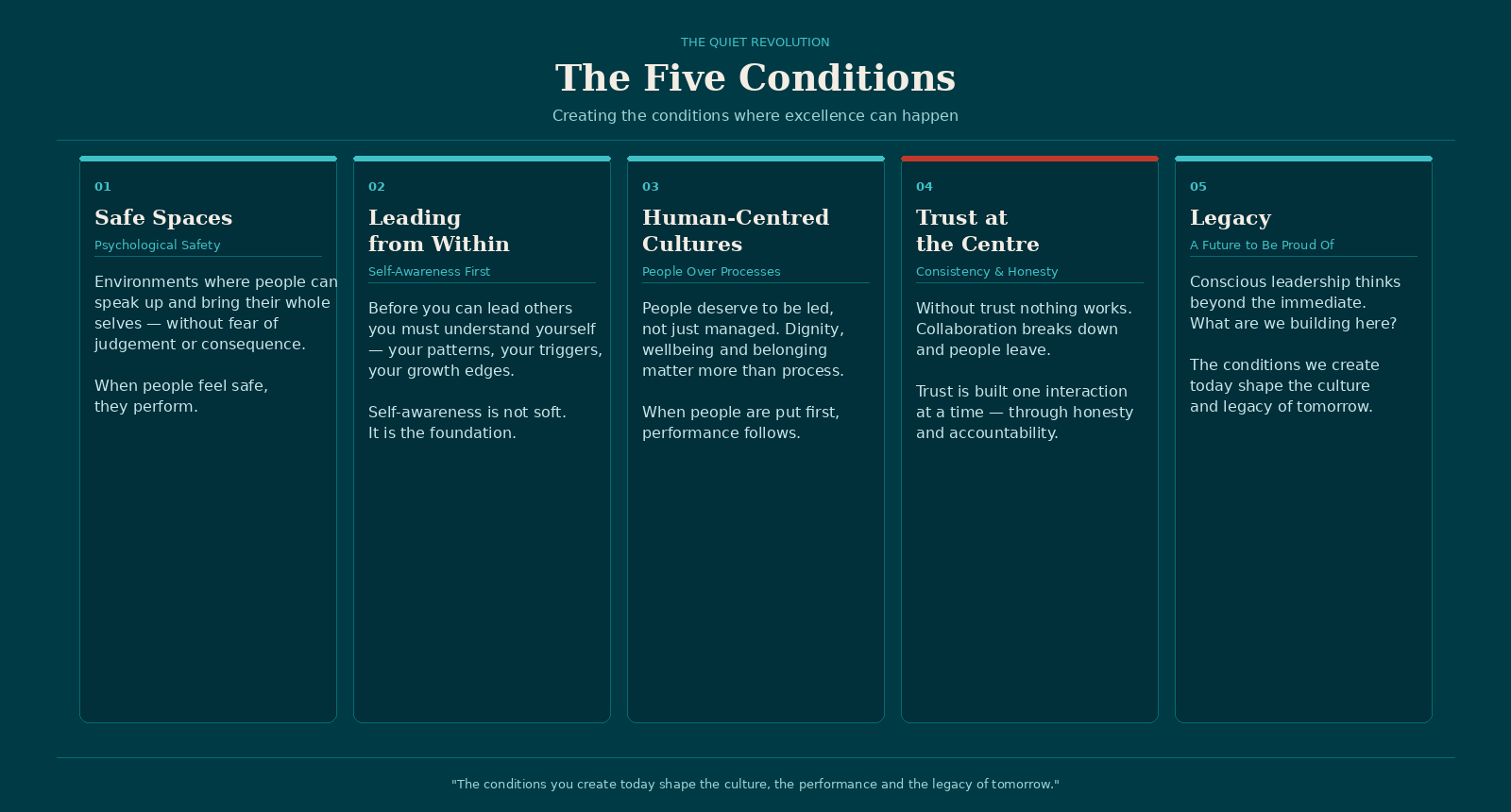
Join the Quiet Revolution:
Creating the Conditions Where Excellence Can Happen